ASCII Art Museum
Timeline
November 2025 — December 2025
Last updated March 27, 2026
Last updated March 27, 2026
Tags
Product Design, Engineering, Museum Studies
Tech
Javascript, Art Institute of Chicago API, textmode.js, Plain old CSS
Background
When I was in college, I took a class on museology and museum history. Through this class, I gained a love and appreciation for the field that led me to writing my honors thesis on the subject. The topic of that thesis covered, among many things, the commodification of experience in the art museum and the transition towards thinking about the art museum visitor as a user of a product. In the years since 2023 when I wrote it, there has been so much technological change and disruption in the art world, specifically through generative AI. While I’m not writing this as a full exploration of the nuances of generative AI, its context is foundational for the background of this project.
The deterioration of objecthood by a digitally connected world has been evident for many years into the 21st century, but it has seen an incredible acceleration by art made with generative AI. The original artifacts become not just irrelevant to the experience but absolutely removed, instead merely fed as fodder to a model that regurgitates them as “style” or “filter,” separating the viewer from the final product’s origins and influences, cheapening the idea of authorship all together. There is a permeating obsession of more that generative AI propels towards like a self-fulfilling prophecy. It insists upon more power, faster outputs, and increased consumption to drive usage.
I want to make it clear that it’s not my intention to paint generative AI in a wholly negative light here. There is vast potential for artificial intelligence to find breakthroughs in science, eliminate tedious aspects of work, and be a partner or critic for thought, but we should consider and challenge the implications and questions that AI brings up surrounding our relationship to objects and environments and how we define art and humanity writ large.
It’s within this frame of reference that I began to think of a project that transgressed against some of the assumptions that generative AI asserts on art and objecthood. What if a digital art experience could pay respect to the objects and artists that it references? What if it could encourage contemplation? In a world increasingly full of AI slop, there is a growing want for something that feels authentic and maybe a touch nostalgic. ASCII art encapsulates both of these ideas. Its abstraction and medium show a charm and ingenuity that feels ironically human, making it a natural fit for this project.
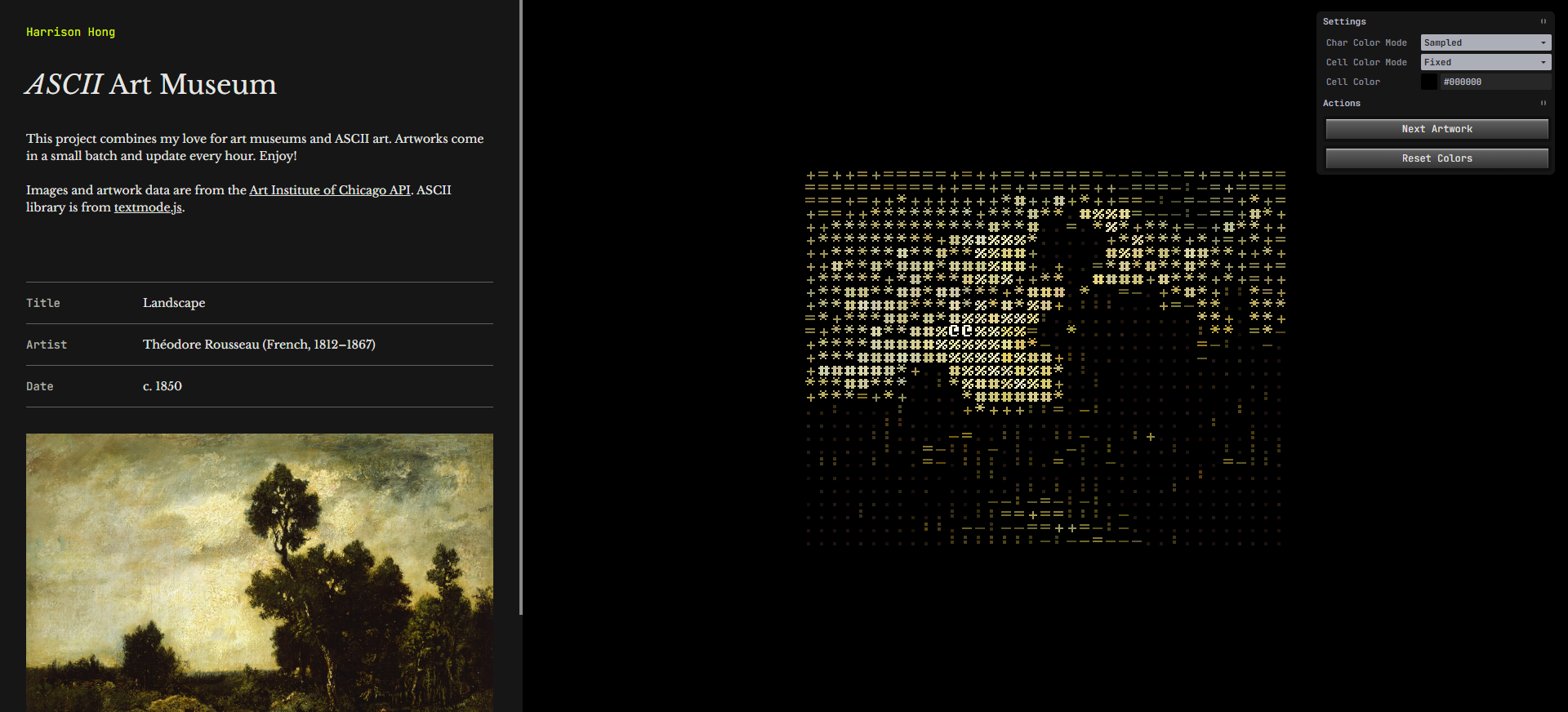
What I’ve created is an ASCII Art Museum that pulls a small batch of artworks from the Art Institute of Chicago API every hour and uses a library called textmode.js to make an ASCII art version of each one. Clicking on the blurred image will reveal the title, artist, date, and original image for each piece.
Process & Iteration
I started by creating separate test projects, one using textmode to load and filter an image into ASCII and the other using the Art Institute of Chicago API to pull images and artwork data. Next I sought to increase my familiarity with the API documentation and added the functionality to gather a set of random artworks and cycle through them in the UI. From there, I combined the two separate projects so that the image returned from the API response was used in the textmode canvas for rendering the ASCII art. It was at this point that I had the idea to have the artwork be “revealed” so that the viewer could consider the ASCII representation first and maybe guess at what it could be. Lastly, I added a Tweakpane control panel to allow users to adjust color settings.
Design Language
I wanted the color and typography to reflect both the art museum and the aesthetics of the terminal interface that ASCII art invokes. This led me to the dark color scheme and the chosen typefaces of Libre Baskerville and JetBrains Mono. Leaning into the nostalgic aspect of ASCII, I went with a more skeuomorphic button design and focused on adding a physicality to the microinteractions like the suppression and shadow of the buttons on press or the slight decrease in blur of the textured reveal overlay on hover to give a peek into what lies underneath.
My hope is that this project encourages visitors to engage with art in new ways and to think about or create connections to artworks and artists. I want it to spark the inspiration to dive deeper or to learn something new.
Reflection
There’s a lot that I would like to add to this project still. A hover interaction with the ASCII art or additional settings for the ASCII font are the first that come to mind. I also think there is potential for cool things with textmode and shaders (possibly a 3D element?).
Through this process, I learned a lot about working with APIs and WebGL, making both seem less daunting to me overall. It was also nice to dive back into thinking about the space of the museum and the relationship between viewer, object, and artist. There's still a lot to explore here, and I look forward to updating this project in the future.